
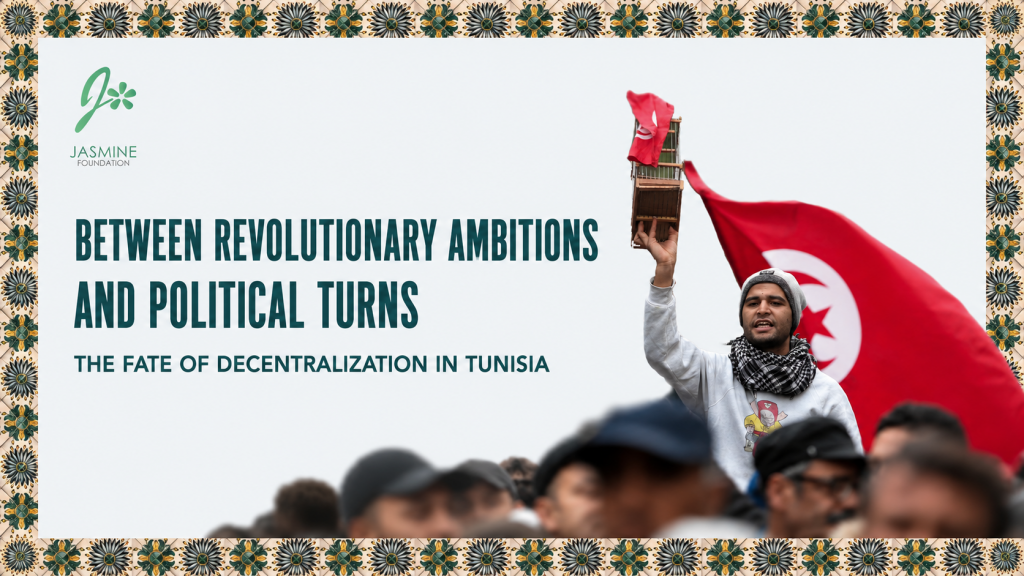
After Tunisia’s 2011 revolution, decentralization emerged as one of the country’s most ambitious democratic projects. It was expected to redistribute authority, bring public services closer to citizens, reduce regional inequalities, and give local communities a meaningful role in shaping their own development.
More than a decade later, however, the future of this project is deeply uncertain.
The report “Between the Revolution’s Ambitions and the Turns of Politics: The Fate of Decentralization in Tunisia” examines the development of local governance from the fall of the former regime through the 2014 Constitution, the 2018 municipal elections, and the political transformations that began on 25 July 2021.
Based on research materials and semi-structured interviews with local governance experts, former mayors, municipal council members, civil society representatives, and practitioners, the study evaluates both the achievements of Tunisia’s decentralization experience and the structural obstacles that prevented its full implementation.
It also examines how the dissolution of elected municipal councils in March 2023 and the return of stronger central administrative control affected municipalities, local development, citizen participation, and civil society.
Decentralization as a Post-Revolution Demand
Following the revolution of 14 January 2011, decentralization was presented as a response to some of Tunisia’s most persistent political and socioeconomic problems.
For decades, public administration, development planning, and financial resources had been concentrated in the capital and major coastal cities. Interior and rural regions experienced higher levels of marginalisation, weaker infrastructure, and limited access to essential services.
Transferring powers to elected local institutions was therefore intended to achieve several interconnected goals:
- Bring public services closer to citizens.
- Strengthen local participation in decision-making.
- Reduce inequalities between regions.
- Improve transparency and accountability.
- Give municipalities the authority to design development programmes based on local needs.
- Build democratic institutions at the level closest to citizens.
The report stresses that decentralization was not intended to weaken the state. Instead, it was meant to create a more balanced and effective state in which central and local authorities cooperate rather than compete.
Special Delegations as a Temporary Solution
After the fall of the former regime in January 2011, the interim government dissolved municipal councils that had been dominated by the former ruling party.
To ensure continuity in municipal administration, these councils were replaced by special delegations composed of civil society activists, political representatives, and individuals with administrative and economic expertise.
A total of 264 special delegations were initially appointed. Although they were designed as temporary bodies, they remained responsible for municipal affairs until the 2018 local elections.
The report identifies several achievements during this transitional period. The delegations ensured the continuity of basic municipal services, opened new opportunities for civil society participation, and introduced a degree of political and social diversity into local administration.
However, they also faced significant structural problems. Their members were appointed rather than elected, which weakened their democratic legitimacy. They operated with limited resources and unclear responsibilities, while political disputes and frequent changes in membership reduced institutional stability.
The extended reliance on temporary delegations also delayed the establishment of elected local government and demonstrated how exceptional measures can become long-term arrangements when political institutions fail to complete the transition.
The 2014 Constitution and the Promise of Local Democracy
The 2014 Constitution represented a major milestone in Tunisia’s democratic transition. Its seventh chapter established a constitutional framework for local government and introduced principles that were unprecedented in the country’s political system.
These principles included:
- Administrative and financial autonomy for local authorities.
- Local self-governance.
- The transfer of responsibilities accompanied by appropriate resources.
- Participatory democracy and open governance.
- Cooperation and solidarity between local authorities.
- A gradual decentralization process covering municipalities, regions, and districts.
Article 139 was particularly important because it required local authorities to adopt mechanisms of participatory democracy and open governance when preparing development and land-use programmes.
This meant that citizens and civil society organisations were not supposed to participate only through elections. They were also expected to contribute to the preparation, monitoring, and evaluation of local policies and development projects.
According to the report, these constitutional principles made Tunisia’s decentralization framework one of the most advanced in the Arab region.
The Gap Between Constitutional Ambition and Implementation
Despite its significance, the 2014 Constitution was never fully implemented.
The creation of several constitutional institutions was delayed, including the Constitutional Court. Political disagreements and frequent government changes weakened the state’s ability to adopt and implement the legislation required for decentralization.
The 2018 Local Authorities Code provided a detailed legal framework for municipalities and local government. Yet many of the implementing decrees needed to put the law into practice were never issued.
According to testimony included in the study, only 12 of the 38 required government decrees were adopted. Many of those addressed secondary administrative matters, while key regulations governing the relationship between municipalities and central state institutions remained absent.
As a result, municipalities often possessed constitutional rights on paper but lacked the legal and administrative tools necessary to exercise them.
This created constant disputes over responsibilities, delayed local projects, and allowed central government institutions to retain powers that were supposed to be transferred to local authorities.
The 2018 Municipal Elections
Tunisia held its first free municipal elections after the revolution on 6 May 2018. The elections represented a historic step toward creating elected local government and expanding democratic participation.
The legal framework encouraged the participation of women and young people. Candidate lists were required to respect gender parity and include young candidates.
More than half of the candidates were between the ages of 18 and 35, and this age group represented approximately 35% of those elected to municipal councils.
Independent lists achieved the largest share of municipal seats, receiving approximately 32.27%. Ennahda received around 28.64%, while Nidaa Tounes obtained approximately 20.85%.
The diversity of party, coalition, and independent lists transformed the local political landscape and created new opportunities for individuals outside traditional political structures.
Nevertheless, electoral participation remained limited. Voter turnout reached only 33.7%, reflecting distrust in political parties, disappointment with unfulfilled promises, limited public awareness of local government’s role, socioeconomic pressure, and practical difficulties in reaching polling stations in some remote areas.
Fragmented Councils and Unstable Coalitions
The political diversity of the elected municipal councils was both an achievement and a source of instability.
Many councils consisted of members from multiple parties and independent lists, with no single group holding a majority. Council presidents were elected internally rather than automatically appointed from the list that received the most votes.
This required alliances and negotiated agreements between different political groups. In some municipalities, this process strengthened compromise and pluralism. In others, it produced repeated conflicts, resignations, and changes in municipal leadership.
The report describes this as a “mosaic” composition: representative of political and social diversity, but difficult to manage without a strong democratic culture and clear procedures for resolving disagreements.
Internal political conflict sometimes overshadowed local priorities, delayed decision-making, and reduced public confidence in municipal institutions.
Responsibilities Without Sufficient Authority
One of the most persistent challenges was the limited practical authority of municipalities.
Although the Constitution and Local Authorities Code recognised local autonomy, central administrative bodies remained reluctant to transfer meaningful powers. Interview participants described this resistance as a form of “institutional jealousy,” in which ministries and senior officials were unwilling to give up responsibilities they had exercised for decades.
Municipalities therefore remained responsible for responding to citizens’ expectations while lacking control over many of the administrative and executive tools required to deliver results.
The situation of the municipal police illustrates this problem. After 2012, the municipal police were placed under the authority of the Ministry of Interior rather than municipal councils.
This left municipalities without a directly controlled enforcement body capable of implementing decisions relating to construction violations, markets, public spaces, environmental offences, and urban regulations.
Municipalities had to request police intervention through security authorities, which could delay or refuse action. Consequently, many municipal decisions remained unenforced, weakening the credibility of elected councils.
Municipal Expansion Without Adequate Capacity
The report also examines Tunisia’s programme of comprehensive municipal expansion.
Before the reform, municipalities covered only around 10% of Tunisia’s territory, mainly in urban areas. Between 2015 and 2016, the government created new municipalities and expanded existing boundaries to include rural communities that had previously existed outside the municipal system.
In 2015, 25 new municipalities were created. A further 61 municipalities were established in 2016, while the boundaries of 190 existing municipalities were expanded.
The objective was to guarantee more equal access to municipal services across the country. However, many newly created municipalities lacked staff, infrastructure, administrative experience, and sufficient financial resources.
Large distances between communities also made service delivery difficult, particularly in rural and interior regions.
The report notes that although rural residents represented a significant proportion of the population newly included in the municipal system, their representation in elected councils remained limited. In one study covering 20 municipalities, rural residents represented approximately 37.1% of the newly incorporated population but received only 16.27% of council representation.
The expansion therefore extended the formal boundaries of local government without always guaranteeing equal political representation or effective access to services.
Conflict Between Decentralization and Deconcentration
A further source of tension was the unclear relationship between decentralization and administrative deconcentration.
Decentralization transfers decision-making authority to autonomous elected local institutions. Deconcentration, by contrast, distributes central government responsibilities to regional representatives who remain part of the state administration, such as governors and district officials.
Tunisia attempted to operate both systems simultaneously without clearly defining their boundaries.
This generated disputes between elected municipal councils and centrally appointed governors. Municipalities referred to their constitutional legitimacy and right to self-governance, while governors and central administrations continued to exercise supervisory powers inherited from the pre-revolutionary system.
These tensions became particularly visible during the COVID-19 pandemic, when central authorities instructed municipalities to coordinate with supervisory institutions before adopting additional local measures.
Some municipalities considered this a restriction on their constitutional authority and their ability to respond quickly to local health conditions.
Financial Resources and Regional Inequality
Municipal independence also remained restricted by limited financial and human resources.
Many municipalities relied heavily on transfers from the central government. Their own-source revenues were often insufficient because of weak tax collection, outdated property records, limited local economic activity, and low levels of compliance with municipal fees.
The distribution of municipal resources was also highly unequal. A limited number of large municipalities accounted for a disproportionate share of local debt and revenue, while municipalities in rural and interior regions struggled to cover essential operating expenses.
New municipalities faced particularly severe shortages. Some lacked qualified staff, adequate offices, equipment, and the administrative systems required to provide basic services.
The report concludes that decentralization cannot succeed when responsibilities are transferred without matching financial resources, trained personnel, or the authority needed to implement decisions.
Civil Society and Participatory Governance
Civil society organisations played a major role in supporting Tunisia’s local governance experiment.
They monitored municipal councils, trained elected members, supported participatory budgeting, facilitated consultations, promoted access to information, and encouraged citizens to participate in local decision-making.
These organisations also helped translate abstract constitutional principles into practical mechanisms. Public meetings, consultations, citizen monitoring, and partnerships between municipalities and associations created new forms of interaction between citizens and local government.
However, the relationship was not always easy. Some municipal leaders viewed civil society scrutiny as interference or competition, while some organisations lacked sufficient understanding of municipal administration and its legal or financial constraints.
Even so, the report considers civil society an essential component of participatory democracy and local accountability.
Following 25 July 2021, the study records a significant decline in civic participation at the local level. Civil society organisations faced increased restrictions, while citizens became less willing to express political opinions publicly.
Many organisations also ended projects related to municipal monitoring and accountability after elected municipal councils were dissolved and replaced by appointed administrators.
The Impact of 25 July 2021
The political measures introduced on 25 July 2021 produced profound changes in Tunisia’s system of government.
President Kais Saied dismissed the government, suspended parliament, and later introduced a new constitutional framework. These developments also affected the institutional position of municipalities.
The Ministry of Local Affairs was abolished and its responsibilities were reintegrated into the Ministry of Interior. According to interview participants, this change strengthened central administrative control and required municipalities to conduct more of their communication with central institutions through governorates.
The report argues that this limited municipalities’ ability to plan projects, communicate directly with ministries, and make independent decisions.
The dissolution of elected municipal councils in March 2023 represented another decisive break with the decentralization process.
Municipal secretary-generals and other appointed officials became responsible for managing local affairs. However, these administrators often lacked the political authority required to approve major projects or make strategic decisions.
According to testimonies included in the report, this situation contributed to delays in development projects, administrative confusion, and the weakening of political participation at the local level.
New Local Councils Without Municipal Autonomy
Local council elections were held in December 2023, followed by a second round in February 2024. The process created 279 local councils under the new political system.
Voter turnout was approximately 12%, and political parties were not permitted to present candidate lists.
Unlike the municipal councils elected in 2018, the new local councils do not possess the same administrative or financial autonomy. Their role alongside municipalities also remains unclear.
The report argues that the new system contains a fundamental contradiction: it presents itself as a model of local and direct democracy while strengthening central authority and limiting the powers available to local institutions.
The lack of clearly defined responsibilities, independent budgets, and stable relations with municipalities raises significant questions about whether the new councils can meaningfully influence development or public services.
The Future of Decentralization in Tunisia
Despite the setbacks identified in the study, the report maintains that decentralization remains essential to Tunisia’s future.
Effective local government can help reduce poverty and regional marginalisation, improve access to services, strengthen accountability, and allow development policies to reflect the specific needs of different communities.
The report’s findings point toward several priorities:
- Restore elected and democratically accountable municipal councils.
- Clearly define responsibilities between municipalities, governors, ministries, and the new local councils.
- Complete the legislative and regulatory framework for local governance.
- Transfer responsibilities together with sufficient financial and human resources.
- Give municipalities effective tools to enforce their decisions.
- Strengthen municipal revenue collection and reduce financial inequality between regions.
- Provide training and institutional support to elected members and municipal administrations.
- Guarantee meaningful citizen participation in development planning and budgeting.
- Protect civil society’s ability to monitor institutions and support local participation.
- Treat municipalities as an integral part of the state rather than as competitors to central authority.
- Ensure transparency and accountability at both central and local levels.
Decentralization as a Means, Not an End
The report concludes that decentralization should not be treated as an end in itself. It is a means of improving governance, supporting sustainable development, and raising citizens’ quality of life.
The Tunisian experience produced genuine achievements. It created elected local institutions, expanded opportunities for women and young people, introduced participatory governance mechanisms, and brought local development into the centre of political debate.
At the same time, implementation was obstructed by incomplete legislation, institutional resistance, political fragmentation, financial inequality, weak administrative capacity, and conflict between elected councils and central state representatives.
The developments after July 2021 placed these achievements at risk and created renewed uncertainty over the future of municipal democracy.
The report therefore calls for continued debate on how Tunisia can preserve the lessons of its decentralization experience, correct its shortcomings, and rebuild a system of local governance capable of serving citizens and supporting inclusive development.
Download the Full Report : Prepared by expert Mr.Taha Bouchadakh and JFRC research department
Read the complete expert study for a detailed analysis of Tunisia’s decentralization experience, municipal governance, the 2018 local elections, civil society participation, and the transformations that followed 25 July 2021: